Diversity in investing is about the seemingly simple idea of spreading your risk, the same holds true with P2P lending.
Defaults happen, this is something you have to live with. Of course lending club bings up their credit score and they do everything they can to collect on the debt but you will still end up having some debt that isn't collected, it's a sad truth. By entering lending with this in mind, that it's a matter of 'when' and not 'if' you'll be able to handle delinquencies much better.
Think back for a moment, if you will, on the last time you took a statistics class, if you have. One of the basic principles is that of normal distribution. If we know that we will definitely lose notes to defaults then we can try to normalize the risk so that it's predictable. Normal distribution says that the mean number defaulted notes we have will fall along a bell curve and that the best way to normalize this curve is to increase the sample size.
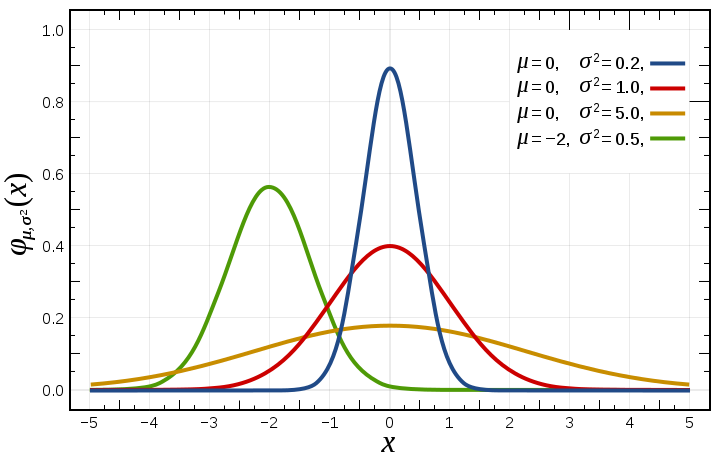
Here's a graph from Wikipedia's article on normal distribution:
The blue line is what we want, the more vertical it is the more predictable our earnings are because we can state with greater confidence that our average will fall somewhere in the middle of that lump.
So, how do we make the line vertical? That's simple: diversity. Buying more notes increases your sample size, this decreases the variance and makes it more likely that our average will match the overall average.
For example, we can say that if you randomly picked 40 notes from lending club (like with lending match) your net earnings will fall within 1.5% above or below the overall average of around 9.5%.
If we double the sample size to 80 notes then the confidence range falls to 1% in either direction
So, what does all of this statistics talk mean? It means that we can formulate general rules about our investments and diversity. Diversity means we increase the sample size, increasing the sample means the results can be more reliably predicted, reliable prediction means that
we aren't gambling, we're taking a
predictable risk to gain a
predictable return.
So, why do we want a predictable return? Because, if you invest your $1000 between 2 notes there's a possibility that 1 could default and you would lose half your money in 1 swoop, this is unpredictable. It is much more unlikely, however, that $1000 split between 40 notes would result in 20 defaults.
By diversifying we reduce more risk than we lose in returns.
So, if you're just starting out you're going to want to keep your investments to
$25-50 per note (my average note size is in the lower 40's), not only will this reduce your exposure to risk but it will also prevent you from the frustration of having a large note default early in the game. If you lose a lot of money early on you're likely to have an emotional reaction and pull your money out, a move that's short-sited and not based on averages, like it should be. Don't get stuck in the situation, just diversify!
Advanced Challenge:
Want to predict your default rate based on normalized distributions? Check out this site:
http://www.surveysystem.com/sscalc.htm
The population is the total number of notes on Lending Club with the credit grades you invest in, the sample is the number of loans in the credit grades you used before that meet your standards for default (IE you can pick charge-offs, charge-offs + >30 days late, etc) and the percentage is 50 (because the default rate on the LC page is the average, or middle, which is 50% on a graph).
The output is a percentage of the average percentage for the groups you picked.
For example, the average across all groups is about 9.5% (.095), you would multiply that by the confidence interval from the calculator (I based this on a sample of 40 notes), which is 15.42% (0.1542) to find out how far above or below 9.5% your 95% confidence interval is.
Is this case, 0.095*.1542=0.0146
This means that we're 95% confident that our average will be greater than 8.04% and less than 10.96% with a random sample of 40 notes.
I know this is some heavy stuff if you've never work in statistics, post a comment if you need help!